Should you pick up a crossbow or a traditional bow? Whether you're a hunter deciding on your first setup, a recreational shooter curious about the difference, or someone returning to archery after a break, this guide breaks down everything: mechanics, accuracy, range, hunting regulations, learning curve, and cost — so you can make a fully informed choice.
⚡ Quick Answer
Crossbows are easier to learn, can be held at full draw indefinitely, and shoot at rifle-like speeds — making them popular with hunters and those with physical limitations. Traditional bows (recurve and compound) demand more skill, offer a deeper archery experience, and are required for Olympic and most target competitions. Your goal determines the winner.
⚙️ How Each System Works
Crossbow
A horizontal bow mounted on a stock, cocked once and held mechanically. You aim and fire like a rifle.
- • Trigger mechanism holds full draw
- • Fires short bolts (not arrows)
- • 150–400+ lbs draw weight
- • 280–450+ FPS velocity
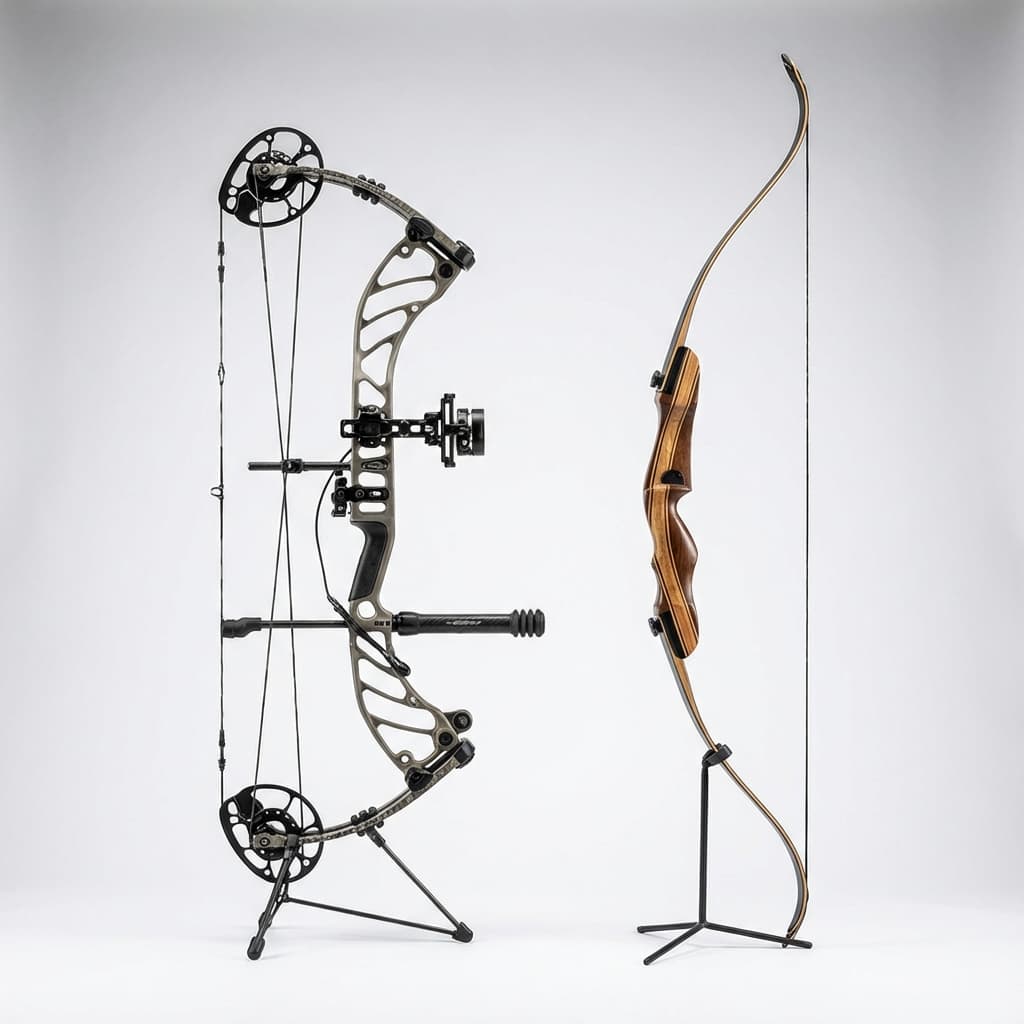
Recurve Bow
A traditional vertical bow with curved limb tips. You manually draw, hold, aim, and release on every shot.
- • Archer holds full weight at draw
- • 20–50 lbs typical draw weight
- • 150–200 FPS velocity
- • Olympic & WA standard
Compound Bow
A modern vertical bow using cams (pulleys) to reduce holding weight. Faster and more accurate than recurve.
- • 65–90% let-off at full draw
- • 50–70 lbs peak draw weight
- • 280–360 FPS velocity
- • Dominant in bowhunting
The fundamental mechanical difference is this: a crossbow does the holding work for you via a trigger sear, while a vertical bow (recurve or compound) requires the archer to draw, hold, aim, and release every single shot under their own muscle power. This single distinction cascades into every other difference — accuracy, fatigue, learning curve, and regulations.
🎯 Accuracy & Effective Range
| Metric | Crossbow | Compound Bow | Recurve Bow |
|---|---|---|---|
| Hunting range (ethical) | 40–80 yards | 30–60 yards | 20–35 yards |
| Target range (competition) | Up to 100 yards | Up to 90 meters | Up to 90 meters |
| Arrow/bolt speed | 280–450 FPS | 280–360 FPS | 150–200 FPS |
| Flat trajectory (forgives ranging) | Excellent | Good | Fair |
| Shot-to-shot fatigue | Very low | Low (let-off) | High |
A crossbow is inherently easier to shoot accurately at moderate distances because it's held like a firearm and has no draw-cycle fatigue. However, a skilled compound archer with thousands of hours of practice can match or exceed crossbow accuracy. The crossbow's advantage is a shorter path to accuracy, not a ceiling advantage.
📋 Hunting Regulations: A Critical Difference
Crossbow hunting regulations vary dramatically by state, province, and country — and this is often the deciding factor for hunters. Getting this wrong can result in serious legal consequences.
States/Provinces where crossbows are fully legal during archery season
Many US states (Alabama, Indiana, Ohio, Georgia, and others) now allow crossbows during the entire archery season with no restrictions. Always verify current regulations with your state wildlife agency before hunting.
States with restricted crossbow use
Some states only allow crossbows during firearms seasons, or restrict crossbow use to hunters with documented disabilities during archery seasons. Examples include parts of Canada and some northeastern US states.
Always check before you hunt
Regulations change frequently. Check your specific state/province wildlife agency website for the current season. What was legal last year may not be legal this year.
For compound and recurve bow hunters, laws are almost universally clear — vertical bows are the default legal weapon for bowhunting archery seasons everywhere. This regulatory certainty is a significant advantage for traditional bow hunters.
📈 Learning Curve Compared
Crossbow
- Day 1: Safe to shoot accurately
- Week 1: Confident at 40 yards
- Month 1: Ready to hunt
- Ongoing: Maintain zero, practice ranging
Fastest path to functional accuracy. Skills transfer from firearm shooting.
Compound Bow
- Week 1–2: Basic form, hitting target
- Month 1–2: Consistent at 20 yards
- Month 3–6: Hunt-ready at 30+ yards
- Year 1+: Refining and extending range
Moderate curve. Let-off helps beginners hold steady while aiming.
Recurve Bow
- Month 1: Basics, hitting target face
- Month 3–6: Consistent at 18 meters
- Year 1: Competing locally
- Year 2+: Advanced technique
Steepest curve. Every form flaw shows. Deeply rewarding to master.
If you've never shot a bow in your life and want to be hunting-ready in the shortest time possible, a crossbow is the clear winner. If you want to develop genuine archery skill and experience the process, a compound or recurve bow delivers a richer journey.
⚖️ Crossbow vs Bow: Pros & Cons
Crossbow
✅ Pros
- • Fastest learning curve to accuracy
- • No fatigue at full draw (trigger holds it)
- • Higher velocity than most vertical bows
- • Rifle-like scope sighting
- • Excellent for hunters with disabilities
- • Great for ambush-style hunting (wait time)
❌ Cons
- • Heavy and bulky (7–10+ lbs)
- • Slow to re-cock between shots
- • Restricted or illegal in some archery seasons
- • Not permitted in most target competitions
- • Expensive ($300–$2,000+)
- • Loud compared to compound bows
Compound Bow
✅ Pros
- • Fast follow-up shots
- • Compact and lightweight (3.5–5 lbs)
- • Legal in all archery seasons
- • Let-off reduces holding fatigue
- • Wide range of accessories
- • Excellent for target and 3D competition
❌ Cons
- • Requires active draw per shot
- • Complex to tune and maintain
- • Needs bow press for string work
- • Moderate learning curve
Recurve Bow
✅ Pros
- • Olympic and WA competition standard
- • Simplest mechanics, easiest to maintain
- • Lightest and most portable
- • Cheapest to start
- • Develops superior archery fundamentals
- • Quiet and elegant
❌ Cons
- • Hold full weight at draw every shot
- • Shortest effective hunting range
- • Slowest arrow speed
- • Steepest learning curve
💰 Cost Comparison
| Item | Crossbow | Compound Bow | Recurve Bow |
|---|---|---|---|
| Bow/Crossbow | $300 – $1,500 | $300 – $800 | $100 – $300 |
| Scope / Sight | Often included | $40 – $200 | $30 – $100 |
| Arrows / Bolts (6) | $40 – $80 | $40 – $80 | $30 – $60 |
| Release / Cocking device | $30 – $100 (crank) | $30 – $150 (release) | $10 – $25 (tab) |
| Target | $50 – $150 (needs special target) | $30 – $100 | $30 – $80 |
| Starter Total | ~$500 – $1,800 | ~$500 – $1,200 | ~$200 – $500 |
Crossbow bolts are shorter and heavier than arrows and wear out faster — especially the nocks, which can crack under the crossbow's rail pressure. Budget for bolt replacement more frequently than traditional arrows.
🤔 Which Should You Choose?
Choose a Crossbow If...
- You have physical limitations (shoulder, arm, or back injuries)
- You want to hunt with minimal practice time
- You prefer a rifle-like shooting experience
- Crossbows are fully legal in your hunting area during archery season
- You hunt from a blind or stand and need to wait at full draw
Choose a Compound Bow If...
- Bowhunting is your primary goal with faster follow-up shots needed
- You want to compete in 3D or field archery events
- You love tuning and customizing your gear
- Archery season regulations in your area restrict crossbows
Choose a Recurve Bow If...
- You dream of Olympic-style competition
- You value tradition, simplicity, and developing pure skill
- Budget is a concern
- You enjoy the challenge of mastering technique over technology
❓ Frequently Asked Questions
Is a crossbow considered a bow for hunting regulations?▼
Is a crossbow more powerful than a compound bow?▼
Can beginners use a crossbow without archery experience?▼
Are crossbows allowed in Olympic archery?▼
What is the difference between a crossbow bolt and an arrow?▼
Track Every Shot with ArcheryBuddy
Whether you shoot a crossbow, compound, or recurve, ArcheryBuddy helps you log sessions, track progress, and analyze your form so you improve faster — whatever weapon you choose.
Quick Summary
- ✓Crossbow: Easiest to learn, rifle-like, best for hunters needing minimal practice time or those with physical limitations. Regulatory restrictions apply in some areas.
- ✓Compound bow: Best all-around for bowhunting and target shooting. Faster follow-up shots, legal everywhere for archery seasons, moderate learning curve.
- ✓Recurve bow: Traditional, Olympic-standard, cheapest to start, steepest learning curve, most rewarding to master.
📚 Related Articles
Compound vs Recurve Bow: Full Comparison
Deep dive into the two main vertical bow types
Archery for Beginners: Your First 30 Days
Complete starter guide for new archers
Archery Draw Weight Guide
Choosing the right draw weight for your goals
How to Choose the Right Arrow Spine
Arrow selection guide for any bow type