Bowhunting for beginners is one of the most rewarding pursuits in the outdoors — and one of the most demanding. Unlike rifle hunting, archery hunting requires you to get close, execute perfect form under pressure, and make ethical shots on live animals. This complete bow hunting guide will walk you through the equipment you need, how to practice effectively, shot placement fundamentals, and the ethics that define a skilled bowhunter.
⚡ Bowhunting Fast Facts
🤔 Is Bowhunting Right for You?
Before spending money on gear, honestly assess your commitment. Archery hunting requires:
- Consistent practice — minimum 3–4 sessions per week in the months leading to season
- Physical fitness — drawing 50–70 lbs repeatedly and hiking with gear demands condition
- Patience — bowhunting success rates are significantly lower than rifle hunting; you must be comfortable with a "no harvest" season
- Ethical commitment — a clean, humane kill requires consistent shot execution under real-world pressure
- Longer seasons as a benefit — most states offer archery seasons that are weeks or months longer than rifle seasons
If you are also new to archery generally, start with our guide on your first 30 days in archery before diving into hunting-specific equipment.
🏹 Bowhunting Equipment for Beginners
The Hunting Bow
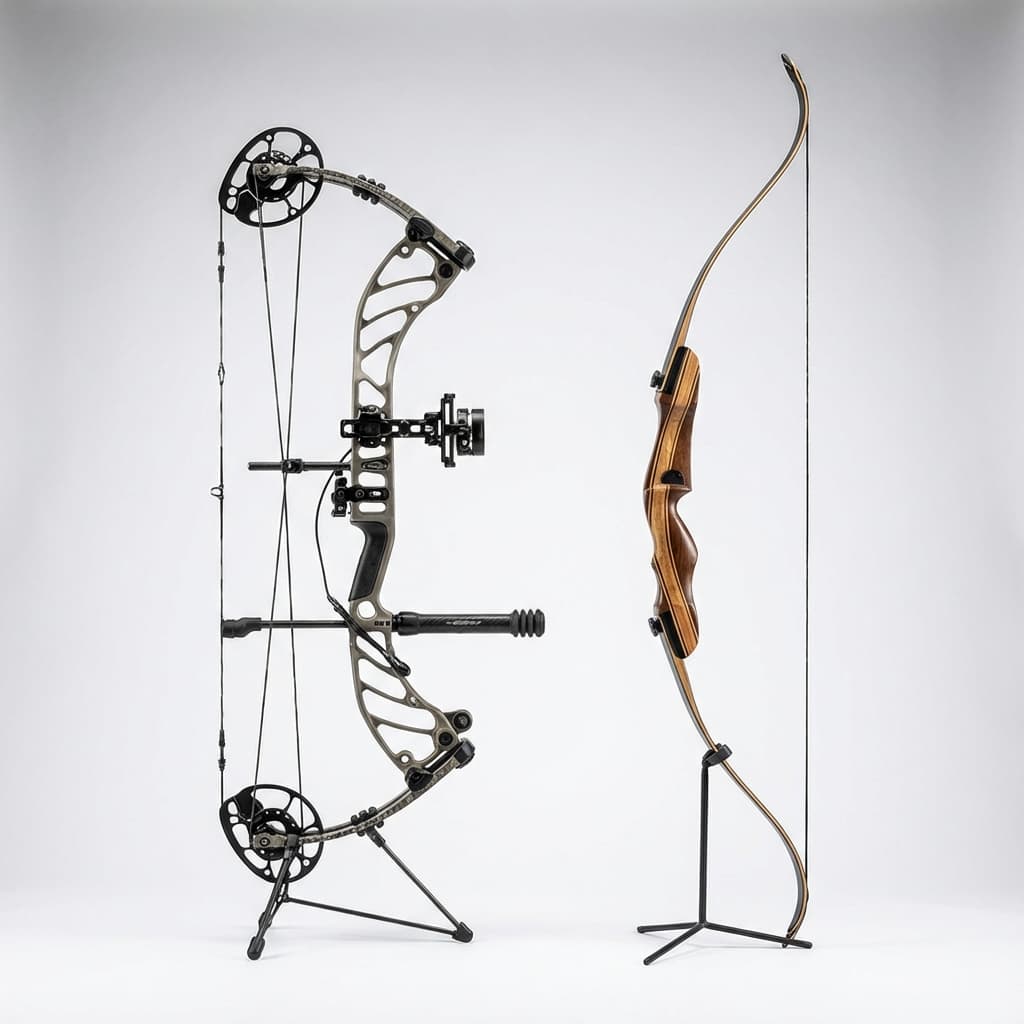
The vast majority of bowhunters use compound bows. The let-off (typically 65–90%) means you hold only a fraction of the peak weight at full draw — critical for holding on a moving animal while waiting for the ethical shot window.
Compound Bow (Most Popular)
- ✅ Let-off allows holding at full draw
- ✅ Faster arrow speeds (250–350+ fps)
- ✅ Mechanical release = consistent trigger
- ✅ More accurate at longer distances
- ❌ More complex to tune and maintain
Recurve / Traditional (Advanced)
- ✅ Simpler, lightweight, quiet
- ✅ Deep tradition; many find it more satisfying
- ❌ No let-off — harder to hold on game
- ❌ Slower, requires closer shots
- ❌ Much longer learning curve
Recommendation for beginners: Start with a compound bow. Once you have taken several animals and feel confident in your woodsmanship, then explore traditional archery hunting if it appeals to you. Do not add difficulty unnecessarily when lives of animals are involved.
Draw Weight for Bowhunting
Draw weight is one of the most important decisions in bowhunting. Unlike target archery where lighter weights are fine, hunting requires enough kinetic energy for clean, ethical kills. Most states have legal minimums — check your regulations.
| Game Animal | Minimum Draw Weight | Recommended |
|---|---|---|
| Small game (rabbit, turkey) | 25–30 lbs | 35–45 lbs |
| Whitetail deer | 40 lbs (most states) | 50–65 lbs |
| Elk, mule deer | 50 lbs | 60–70 lbs |
| Bear, moose | 50–60 lbs | 65–75 lbs |
For a deeper understanding of how to select the right draw weight and build up safely, see our dedicated archery draw weight guide.
Hunting Arrows
Hunting arrows differ significantly from target arrows. They need to be stiffer (higher spine), heavier (for momentum and penetration), and tipped with broadheads rather than field points.
Arrow Weight
Heavier arrows (400–500+ grains total weight) penetrate better and are quieter in flight. Lighter arrows fly flatter but sacrifice penetration. For hunting, aim for 6–8 grains per pound of draw weight as a minimum. A 60 lb bow should shoot arrows of at least 360 grains.
Arrow Spine for Hunting
Broadheads fly differently than field points — they act like a vane themselves. This magnifies spine errors. Use a spine one step stiffer than your target setup, or paper tune specifically with your broadheads. See our arrow spine guide for the full selection process.
Broadheads: Fixed vs Mechanical
Fixed Blade Broadheads
Blades are always open. More reliable in all conditions. Better penetration on heavy bone. Excellent choice for beginners because no deployment mechanism can fail.
Examples: Muzzy 3-Blade, G5 Montec, Slick Trick
Price: $30–$50 per 3-pack
Mechanical (Expandable) Broadheads
Blades fold back for flight, open on impact. Larger wound channels. Fly more like field points, making accuracy easier. Risk: deployment failure on quartering shots or heavy bone.
Examples: Rage Hypodermic, NAP Spitfire
Price: $40–$60 per 3-pack
⚠️ Critical: Always Practice With Your Hunting Broadheads
Never switch from field points to broadheads for the first time on opening day. Broadheads change your point of impact. Practice with screw-in practice broadheads (same weight as your hunting heads) for at least 4–6 weeks before season. Tune until your broadheads and field points hit the same point at 20 yards.
🎯 Shot Placement: The Ethical Bowhunter's Priority
Shot placement is the single most important factor in ethical bowhunting. Unlike rifle hunters, bowhunters kill via hemorrhage — the arrow must pass through both lungs (and ideally the heart) to ensure a rapid, humane death. Understanding shot angles is non-negotiable.
Broadside Shot — Best Option
Animal standing perpendicular to you. Aim just behind the front leg, one-third up from the bottom of the chest. This gives the largest target for both lungs. Recovery is typically fast. Wait for this shot whenever possible.
Quartering Away — Excellent Option
Animal angled away from you. Aim to exit through the far shoulder — this means aiming further back on the near side. Passes through the liver and both lungs. Excellent penetration angle. Second-best option after broadside.
Quartering Toward — Avoid for Beginners
Animal angled toward you. Very small window between the near shoulder and vitals. High risk of hitting shoulder bone and deflecting the arrow. Experienced bowhunters sometimes take this shot; beginners should pass and wait for a better angle.
Head-On / Straight-Away — Never Shoot
No ethical shot exists on an animal facing directly toward or directly away from you. Facing you presents no vital zone target. Straight away risks a gut shot following the spine. Pass on these shots every time.
📏 How Far Should You Practice and Hunt?
Many new bowhunters make the mistake of practicing at long distances before they have mastered short-distance consistency. Here is the correct progression:
| Phase | Practice Distance | Accuracy Standard | Max Hunting Distance |
|---|---|---|---|
| Month 1–2 | 10–20 yards | All arrows in 6" group | Not yet hunting |
| Month 3–4 | 20–30 yards | All arrows in 4" group at 30 yds | 20 yards |
| Month 5–6 | 30–40 yards | Consistent 4" groups at 40 yds | 30 yards |
| Season-ready | 40–60+ yards | 3" groups at 40 yds consistently | 40 yards (ethical) |
💡 The 3D Archery Training Secret
3D archery courses are the best practice tool for bowhunters. They simulate real hunting scenarios — unknown distances, uphill and downhill angles, partial obscurement, and the need to judge range without a rangefinder (in unmarked courses). Find a local 3D archery club and shoot as many courses as possible in the months before your season. Read our complete 3D archery guide to learn how courses work.
🎒 Complete Bowhunting Gear List for Beginners
Core Equipment
- ✅ Hunting compound bow (50–70 lbs)
- ✅ Wrist strap release aid
- ✅ Hunting arrows (6+ properly spined)
- ✅ Broadheads (fixed or mechanical)
- ✅ Multi-pin bow sight (20, 30, 40, 50 yd pins)
- ✅ Arrow rest (drop-away recommended)
- ✅ Quiver (bow-mounted for hunting)
- ✅ Peep sight
Accessories & Safety
- ✅ Rangefinder
- ✅ Tree stand or ground blind
- ✅ Treestand safety harness (non-negotiable)
- ✅ Hunting license and tag (check state regs)
- ✅ Scent control clothing
- ✅ Field dressing knife
- ✅ Blaze orange (where required)
- ✅ Headlamp for pre-dawn entry
🌿 Bowhunting Ethics: The Unwritten Code
Ethics in bowhunting go beyond what the law requires. They define the culture of the sport and separate skilled, responsible hunters from those who give archery hunting a bad reputation.
Know Your Effective Range — And Stay Within It
Your maximum practice distance is NOT your maximum hunting distance. Adrenaline, wind, awkward positions, and low light all reduce your effective range. Cut your maximum practice distance in half for hunting until you have years of experience.
Pass on Marginal Shots
It takes more discipline to not shoot than to shoot. If the angle is wrong, the shot is blocked, or you are unsure — pass. The animal will often present another opportunity, or you will encounter another. A wounded, unrecovered animal is the worst outcome in bowhunting.
Always Recover Your Animal
Wait at least 30 minutes (ideally 60 minutes) before tracking after a lung shot. Use blood trailing skills, bring friends, and consider a trained blood tracking dog if available. Utilise every part of the animal you can.
Respect the Land, Other Hunters, and the Animal
Follow property boundaries, practice Leave No Trace principles, and give other hunters space. The bowhunting community's reputation depends on individual behaviour.
Track Your Bowhunting Practice
Use ArcheryBuddy to log every practice session, track distance accuracy, and analyse your form with AI so you are ready when the moment counts. Available free on iOS and Android.