Wind is the great equalizer in outdoor archery. The same archer who shoots tight groups on a calm day can scatter arrows across the face on a gusty one — unless they know how to read and adapt to the conditions. Shooting in wind is a skill in itself, one that separates outdoor archery specialists from range shooters. This guide covers everything from understanding how wind actually affects your arrows to practical sight adjustments, arrow selection, and body position changes that will keep you competitive no matter what the weather throws at you.
💨 Wind Shooting Quick Facts
- • A 10 mph crosswind at 70m can move an arrow 10-15 cm off center
- • Heavier arrows drift less in crosswind than lighter arrows
- • Wind affects arrow flight time — headwinds slow arrows, tailwinds speed them up
- • The middle portion of flight is when wind has the most influence
- • Practice in wind regularly — you cannot learn wind shooting on calm days
🌬️ How Wind Actually Affects Arrow Flight
Understanding the physics of wind drift in archery helps you make better decisions about when and how to compensate. Wind does not affect all arrows equally, and the relationship is not as simple as "more wind = more drift."
Crosswind (Side Wind)
A true crosswind blows perpendicular to your shooting line. The force acts on the arrow's surface area during flight — primarily the fletching and shaft. Arrow driftis determined by:
- Wind speed — the primary factor; doubling wind speed roughly quadruples drift
- Arrow flight time — slower arrows spend more time in the air and drift more
- Arrow weight — heavier arrows have more momentum and resist deflection
- Fletching size — larger fletching catches more wind; smaller vanes drift less
- Distance — drift compounds with distance; 70m drifts far more than 18m
Headwind and Tailwind
Head and tailwinds affect arrow velocity and therefore elevation. A headwind slows the arrow, reducing its flat-trajectory range — your arrow will drop more than normal and hit low. A tailwind has the opposite effect, with the arrow carrying higher at distance.
Head/Tailwind Effects Summary
| Wind Type | Effect on Arrow | Correction |
|---|---|---|
| Strong headwind | Arrow hits low; slowed down | Move sight down (aim higher) |
| Strong tailwind | Arrow hits high; carries further | Move sight up (aim lower) |
| Left crosswind | Arrow drifts right | Move sight right (aim left of target) |
| Right crosswind | Arrow drifts left | Move sight left (aim right of target) |
Variable Wind: The Real Challenge
The hardest wind to shoot in is not a steady 15 mph crosswind — it is variable, gusty wind that changes speed and direction between arrows. In this environment, the ability to read the wind and choose your moment becomes as important as shooting technique.
🚩 Reading Wind Conditions at the Range
Elite outdoor archers are constantly watching environmental cues to assess wind speed and direction. At an outdoor range, you have multiple sources of wind information available.
🚩 Wind Flags
Most outdoor archery ranges have wind flags (small flags on poles at various points down the range). Reading multiple flags simultaneously tells you if the wind is consistent across the shooting lane or if there are differential currents. A flag drooping 45 degrees indicates roughly 10-12 mph; fully extended is 20+ mph. Flags moving rhythmically signal gusts you can time; random movement indicates unpredictable conditions.
🌿 Grass and Trees
Before flags were common, archers read grass movement. Grass bent steadily at roughly 30° indicates moderate wind. Tree branches swaying indicate stronger gusts. The key is watching beyond the shooting line — what is happening at mid-range and near the target is more relevant than what you feel on your face.
👁️ Mirage (Heat Shimmer)
In warm conditions, the heat shimmer (mirage) visible through a spotting scope actually indicates wind direction. Mirage flowing sideways indicates crosswind in that direction. Mirage "boiling" straight up indicates very low wind — a good shooting window. This is an advanced technique used by experienced outdoor target archers.
💧 Wet Finger Test
A wet finger held up shows wind direction from the cooling sensation — the side that feels coldest faces the wind. Useful for identifying direction when flags are not available, but less useful for estimating speed.
In gusty conditions, the most effective strategy is to wait for the lull. Watch the flags. When the wind drops to its lowest point between gusts, shoot. Elite outdoor archers are incredibly patient — they will let a timer run close to its limit to catch that 3-second window of calm. Practice this patience on windy training days.
🎯 Sight Adjustments for Wind
There are two schools of thought on wind adjustments in target archery: adjusting your sight, or aiming off (holding off the center). Both have merit in different situations.
Moving the Sight
Best for steady, consistent wind that is not changing.
- • Move sight in the direction the wind blows (follow the arrow)
- • Allows you to keep aiming at the center of the face
- • More precise for competition
- • Requires knowing your wind values for each wind speed
- • Risk: if the wind drops, your next arrow is off
Aiming Off (Holding)
Best for variable, changing wind conditions.
- • Keep sight centered; move your aiming point on the target face
- • Faster to adjust between arrows
- • Good for when wind is inconsistent between shots
- • Can aim off specific scoring rings to compensate
- • Risk: harder to be precise without known wind reference points
Building Your Personal Wind Chart
Every archer's wind value is different — it depends on your arrow weight, speed, fletching size, and shooting distance. The only way to know your exact wind compensation values is to test in known conditions. Here's how to build your personal wind chart:
- 1. On a day with a steady, measurable wind, shoot a group of arrows at your competition distance without any wind adjustment.
- 2. Measure how far the group center has drifted from your aiming point.
- 3. Note the wind speed (use a small anemometer or weather app) and direction.
- 4. Calculate: that drift amount = your wind value for that speed at that distance.
- 5. Repeat at different wind speeds and distances to build a complete reference table.
- 6. Record these values in your archery log — refer to them in competition conditions.
🏹 Arrow Selection for Windy Conditions
Your arrow choice directly affects how much wind influences your shot. Understanding this helps you make intelligent equipment decisions for outdoor competition.
Arrow Properties That Affect Wind Drift
- • Arrow weight (GPI — grains per inch) — heavier arrows drift less. A 9 GPI arrow drifts significantly less than a 6 GPI arrow in the same crosswind.
- • Diameter — thinner arrows present less surface area to the wind and drift less. This is why thin-diameter arrows are preferred by Olympic archers for outdoor competition.
- • Fletching size and height — smaller vanes catch less wind. Many outdoor target archers use low-profile spin vanes rather than large plastic vanes to minimize wind effect.
- • Arrow velocity — faster arrows spend less time in the air and drift less. A faster setup helps in windy conditions.
| Condition | Ideal Arrow Choice | Why |
|---|---|---|
| Calm / Indoor | Lighter, larger vanes | Maximum stability; wind not a factor |
| Light breeze (<10 mph) | Medium weight, small-medium vanes | Balance of stability and wind resistance |
| Strong crosswind (>15 mph) | Heavier, thin-diameter, small spin vanes | Minimum drift; momentum beats wind |
For comprehensive arrow selection advice beyond wind, see our arrow spine selection guide.
🧍 Body Position Adjustments in Wind
Wind does not just affect the arrow — it affects you. A strong crosswind pushes against your body, affecting your stance stability and potentially introducing lateral bow movement at the shot. Adjusting your body position can significantly reduce these effects.
👣 Stance Adjustment
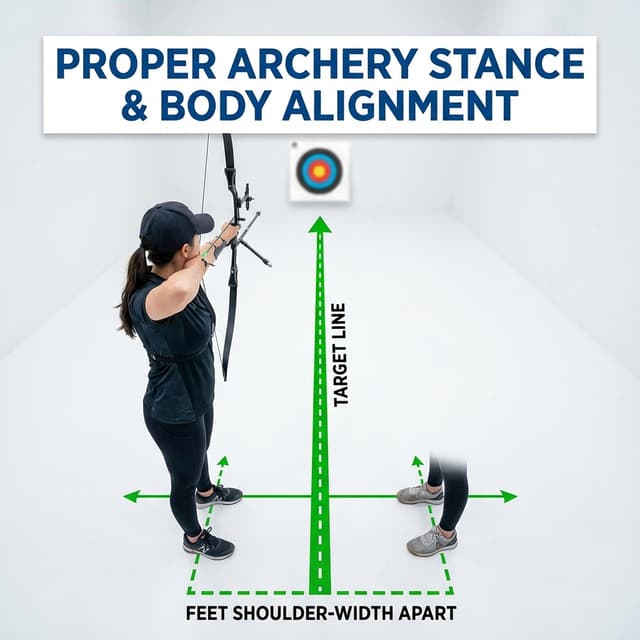
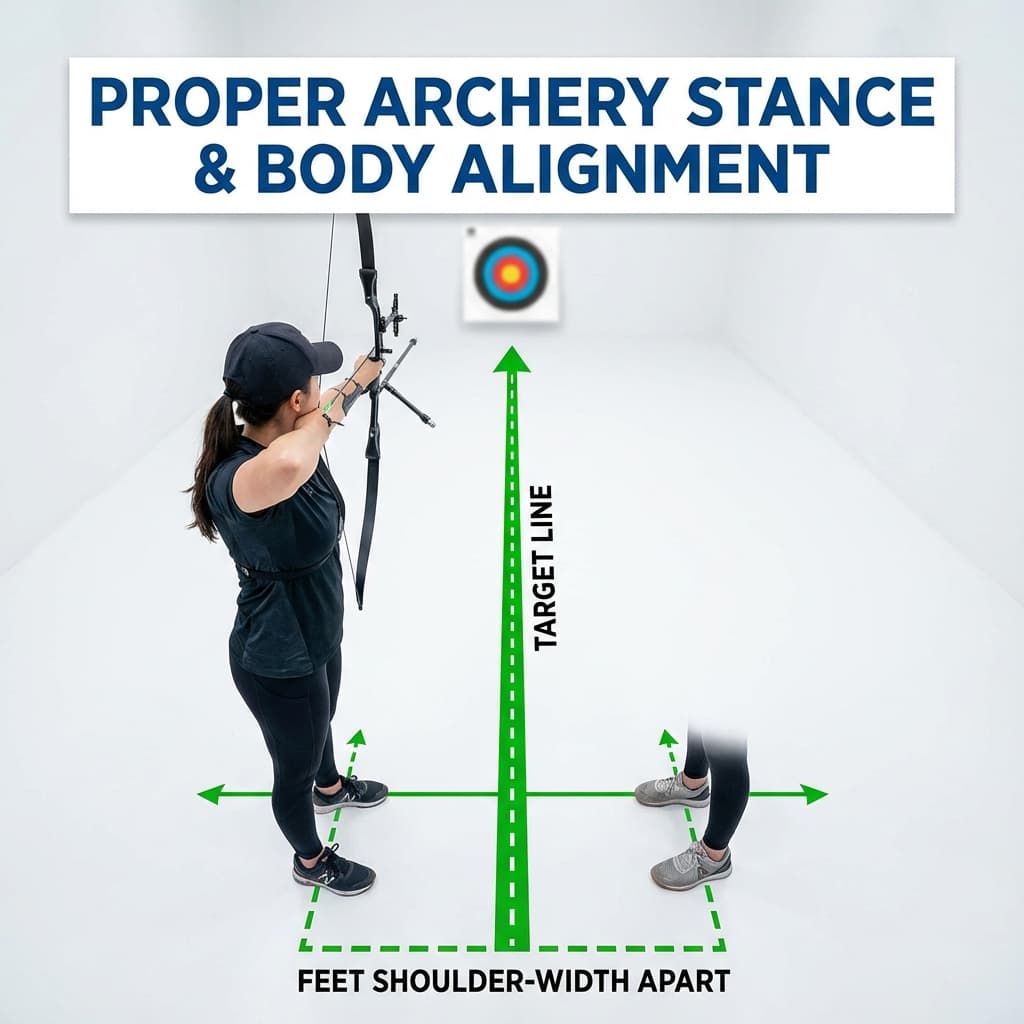
In a strong crosswind, widen your stance slightly for a lower center of gravity and better stability. Some archers also rotate their stance slightly to present less body surface area to a headwind. Avoid too drastic a change — your stance affects your draw alignment and should stay fundamentally consistent. See our archery stance guide for foundational stance principles.
💪 Grip and Bow Arm Stability
Wind can cause your bow arm to drift laterally during the hold. Resist the urge to grip tighter to compensate — increased grip tension creates torque. Instead, focus on shoulder stability through the draw. Good bone alignment (locking out the bow arm properly) resists lateral wind pressure better than muscle tension.
🫁 Breathing in Wind
In gusty conditions, your breathing timing becomes even more important. Shoot in the lull between gusts, coordinating your breath hold with the wind break. Do not hold your breath longer than comfortable — oxygen deprivation causes tremors that defeat the purpose of waiting for a calm moment.
🎽 Clothing in Wind
Baggy clothing catches wind and can affect how your bow arm sits at full draw — especially if a sleeve catches the string. In windy competition, wear fitted, non-billowing clothing. An arm guard also helps keep sleeves out of the string path regardless of conditions.
🧠 The Mental Game in Windy Conditions
Windy conditions affect every archer on the line equally. The archers who score best in wind are not necessarily those with the best technique — they are often those with the best mental approach to uncontrollable conditions.
Wind Mental Strategies
- • Accept what you cannot control. Wind is the same for everyone. Focusing on what you can control — timing, technique, patience — keeps you performing while others get frustrated.
- • Lower your score expectations; raise your process standards. A 7 in heavy wind is sometimes the right result. Judge yourself by decision quality, not just score.
- • Stay patient with timing. Rushing a shot to beat a timer in variable wind almost always leads to a poor arrow. Waiting for the lull is the correct decision even when it is uncomfortable.
- • Build a wind-specific pre-shot routine step. Add an explicit wind-check before drawing — look at the flags, assess the conditions, make your decision, then execute. This prevents the mental scramble of remembering to account for wind mid-draw.
🏋️ How to Practice for Windy Conditions
You cannot develop wind-reading skills and wind-adjusted technique by practicing only on calm days. Schedule outdoor practice sessions specifically in windy conditions — even uncomfortable ones. The discomfort of practice in wind is the tuition you pay for composure in competition.
- Shoot a first group with no compensation to see your natural drift in the day's conditions
- Measure and note the drift distance and estimated wind speed
- Adjust your sight or holding point and shoot a second group to verify the correction
- Practice timing your shots to the lulls in gusty conditions
- Record your wind values in your archery journal or app for future reference
- Vary the wind directions you practice in — pure crosswind, headwind, quartering wind
Keep a dedicated wind log: date, location, wind speed and direction, distance, arrow setup, and the sight adjustment required. Over time, you will build a personal wind reference database that makes competition wind adjustments much faster and more accurate.
🧭 Quartering Winds and Combined Effects
Real-world wind is rarely a pure crosswind or a pure headwind. Most competition wind arrives at an angle — what sailors call a quartering wind. A quartering wind has both a lateral component (causing drift) and an along-the-line component (affecting velocity and elevation). You must account for both.
Quartering Wind Adjustment Method
- 1. Identify the angle — is the wind more crosswind than headwind, or vice versa?
- 2. Calculate the crosswind component — if the wind is at 45°, the lateral component is approximately 70% of the full wind speed.
- 3. Calculate the along-line component — the remaining ~70% acts as a head or tailwind.
- 4. Apply both corrections — adjust sight horizontally for drift, and fine-tune elevation for the velocity component.
- 5. Start conservatively — split the difference and correct from impact data rather than trying to calculate perfectly before the first arrow.
📌 Wind Shooting Quick Reference
- Crosswind — move sight into the wind; arrow follows the wind laterally
- Headwind — arrow hits lower; move sight down to compensate
- Tailwind — arrow carries higher; move sight up to compensate
- Variable wind — aim off rather than adjusting sight; wait for lulls
- Heavy arrows drift less than light arrows in crosswind
- Small, low-profile vanes are more wind-stable outdoors
- Widen stance slightly for lateral stability in strong wind
- Accept wind as a shared challenge — patience beats frustration every time
The archer who masters wind shooting gains a permanent advantage at every outdoor tournament. While other competitors complain about the conditions, you will be reading the flags, timing your shots, and shooting confidently through conditions that rattle everyone else. Wind mastery does not come quickly — but every breezy practice session is an investment that pays out on competition day.
Log Your Wind Sessions with ArcheryBuddy
Track your wind shooting sessions, record your sight adjustments for different wind speeds, and build your personal wind reference database. ArcheryBuddy helps you make sense of your outdoor practice so every windy competition feels familiar.