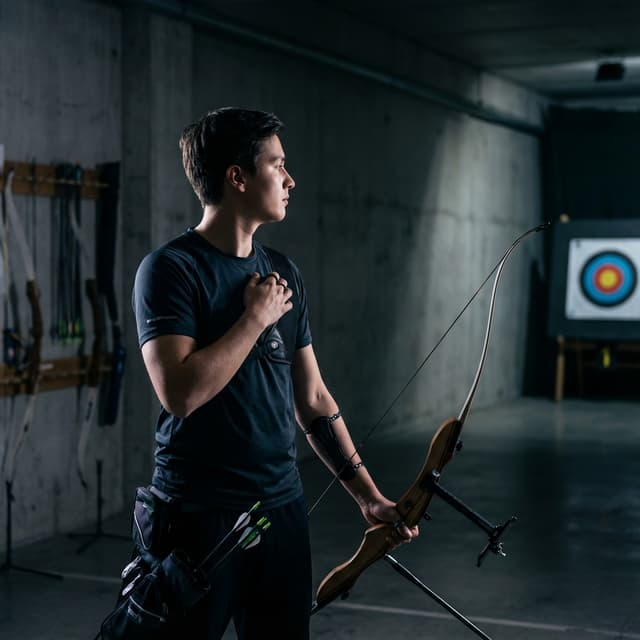
There is something profoundly satisfying about drawing a longbow or a simple recurve, looking down the arrow without a sight, and releasing — feeling connected to thousands of years of human history. Traditional archery strips the sport back to its essentials: you, a bow, and an arrow. No sights. No releases. No cams. Just pure instinct and skill. This complete guide covers everything from equipment choices to instinctive aiming, so you can start your traditional archery journey with confidence.
🏹 Traditional Archery at a Glance
- • Includes longbows, recurve bows (shot barebow), and selfbows
- • No sights, no mechanical releases, no stabilizers — just the bare bow
- • Aiming methods: instinctive shooting, gap shooting, and string walking
- • One of the fastest-growing segments of archery worldwide
- • Demands more practice but offers deep personal satisfaction
📜 A Brief History of Traditional Archery
The bow and arrow has been a human tool for at least 70,000 years. From the Mongolian horse archers who conquered much of the known world, to the English longbowmen at Agincourt, to the Apache warriors of the American Southwest — traditional archery is woven into the fabric of human history on every continent.
The English longbow, typically made from yew wood and standing as tall as the archer, had a draw weight of 80–185 lbs and was effective at ranges over 200 yards. The recurve bow, with its distinctive curved limb tips, was developed by nomadic cultures who needed a shorter, more powerful bow usable from horseback.
Modern traditional archery is practiced as a sport, a meditative practice, and a connection to heritage. It shares range space with compound archers but occupies a very different philosophical space — one of simplicity, patience, and personal development.
⚖️ Longbow vs Recurve: Which Should You Choose?
The first major decision for a traditional archery beginner is whether to shoot a longbow or a barebow recurve. Each has distinct characteristics that suit different archers and shooting styles.
The Longbow
- • D-shaped or slight recurve profile — simple, elegant design
- • Typically 60–72 inches in length
- • More forgiving of arrow spine variation
- • Quieter shot — fewer limb tips to vibrate
- • Very traditional aesthetic — appeals to history enthusiasts
- • Generally slower arrow speed than a recurve at same draw weight
- • Excellent for instinctive shooting and roving
- • Best known style: English longbow, American flatbow
The Barebow Recurve
- • Recurved limb tips store more energy — faster arrow speed
- • More versatile — takedown models allow limb swapping
- • Can use a sight, stabilizer, clicker (Olympic recurve) or go bare
- • Shorter length makes it easier to maneuver in 3D terrain
- • Supports string walking as an aiming technique
- • More accessories available
- • Steeper learning curve for instinctive shooting due to faster arrow
- • Used in Olympic competition (with sight)
Recommendation for Beginners
If you are drawn to history, simplicity, and a meditative shooting style — start with a longbow. If you want more versatility and potential to move into competition, a takedown recurve gives you more options over time.
Either way, start with a lighter draw weight — 25–35 lbs is ideal for learning form. You can always move up once your form is solid. See our guide on choosing draw weight for a detailed breakdown.
🛠️ Traditional Archery Equipment Essentials
The Bow
For a first traditional bow, look for a reputable manufacturer such as Bear Archery, Three Rivers Archery, Samick, or Southwest Archery. A quality beginner longbow or recurve runs $100–$300 and will serve you well through years of learning. Avoid ultra-cheap bows with unknown limb materials — the limbs are the most safety-critical component.
Arrows for Traditional Archery
Arrow selection is particularly important for traditional bows because the archer's paradox — the way an arrow bends around the bow during release — is more pronounced without a center-shot riser. Traditional bows require carefully matched arrows.
Arrow Options for Traditional Archery
- • Wood arrows — the most traditional choice. Pine, cedar, and Douglas fir are common. Must be matched by weight and spine to each individual arrow in a set.
- • Bamboo arrows — excellent for Asian-style traditional archery; lighter and faster than wood.
- • Carbon arrows — very popular with modern trad archers. Consistent spine, durable, and perform well from longbows and recurves. See our arrow spine guide for selection help.
- • Aluminum arrows — a middle-ground option: affordable, consistent, and durable enough for most beginners.
Tab, Glove & Bracer
Finger Tab
A flat leather or synthetic pad that covers the three draw fingers. Preferred by most traditional archers for consistency and feel. Allows good string contact feedback.
Shooting Glove
Three-finger leather glove — traditional and comfortable. Less consistent than a tab for competition but natural-feeling for barebow and hunting styles.
Bracer (Arm Guard)
Essential for beginners. Protects the bow arm from string slap while you develop consistent form. Even experienced trad archers wear them occasionally.
👁️ Aiming Methods in Traditional Archery
This is where traditional archery diverges most dramatically from modern target archery. Without a sight, how do you know where the arrow will go? There are three main methods, each with its own philosophy and learning curve.
1. Instinctive Archery
Instinctive shooting (also called "snap shooting" or "subconscious aiming") is the most traditional method. The archer focuses entirely on the target — not the arrow tip, not any reference point — and through extensive practice, the subconscious mind learns to direct the body to release at the correct moment. Think of it like throwing a ball: you don't consciously calculate trajectory, you just throw.
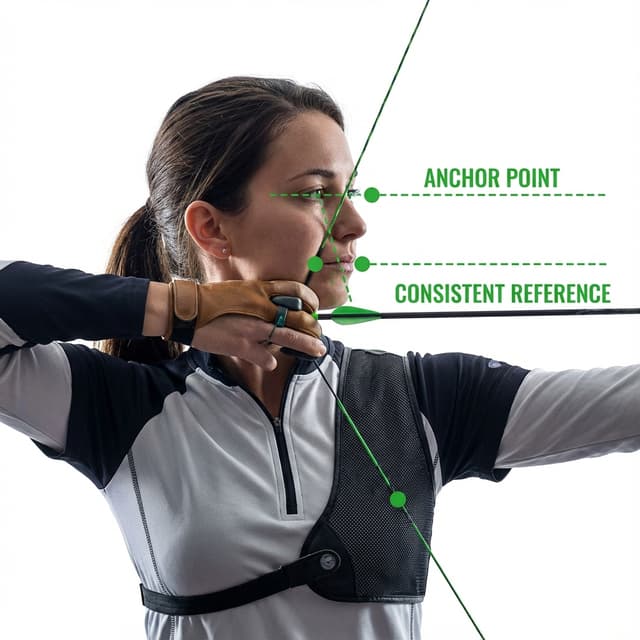
Instinctive archery requires a consistent anchor point, identical form every shot, and thousands of repetitions. Your brain must receive consistent data — the same anchor, the same head position, the same draw length — to calibrate its internal computer. Form inconsistency is the enemy of instinctive accuracy. See our anchor point guide for help establishing a solid anchor.
2. Gap Shooting
Gap shooting is a semi-conscious aiming method where the archer uses the arrow tip as a reference point and learns the "gap" — the offset between the arrow tip and the target — at different distances. At 20 yards, you might aim with the tip 6 inches below the bull. At 30 yards, the tip might be right on. At 10 yards, you might aim 2 feet above.
Gap shooting is generally easier to learn than pure instinctive and allows for more conscious adjustment. Most beginners find themselves using a form of gap shooting naturally. Over time, some transition to purely instinctive shooting; others remain dedicated gap shooters at a high level.
3. String Walking
String walking involves moving the draw fingers up or down the string by a measured amount to change the arrow's trajectory. At short distances, you crawl your fingers farther down the string; at long distances, you anchor at the top. This allows the archer to aim directly at the target across all distances — essentially simulating a sight through finger position.
String walking is the most consistently accurate barebow method and is used by barebow competition archers. However, it is not permitted in traditional classes that require shooting off the shelf or in instinctive-only competitions.
| Method | Learning Curve | Best For | Competition Legal? |
|---|---|---|---|
| Instinctive | Steep — months to years | 3D, roving, hunting | All trad classes |
| Gap Shooting | Moderate — weeks to months | Target, 3D, general | Most trad classes |
| String Walking | Moderate — requires measuring | Barebow competition | Barebow only (not trad) |
🎯 Traditional Archery Form Fundamentals
Good traditional archery form follows the same fundamental principles as any archery — stance, grip, draw, anchor, aim, release — but with some key differences due to the absence of a mechanical release and the need to shoot off the fingers consistently.
🦶 Stance
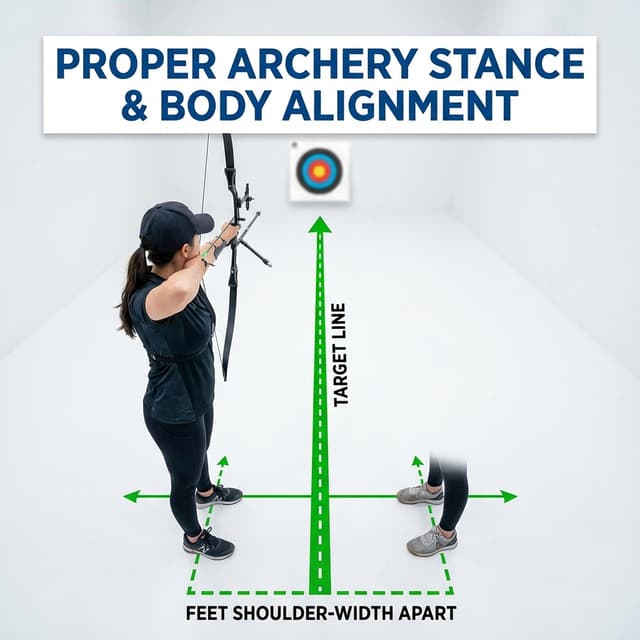
Square or open stance both work in traditional archery. Many traditional archers prefer a more open stance (turning the body toward the target) than Olympic recurve archers — this opens the draw shoulder and helps prevent string slap.
✋ Bow Hand Grip
The low wrist grip is most common — the bow rests in the web of the thumb with minimal hand contact. Avoid a death grip. Many traditional archers use shooting off the shelf (the arrow rests on the bow hand's shelf or a simple leather rest) rather than a raised rest, further emphasizing a relaxed hand.
🤌 Drawing Hand & Fingers
Most traditional archers use a three-finger draw (Mediterranean style) — one finger above the nock, two below. The "split finger" or "three under" style is also used, especially for instinctive shooting at closer ranges. Keep the drawing hand relaxed with consistent finger placement every shot.
⚓ Anchor Point
Traditional archers typically use a corner-of-mouth anchor or a cheek anchor. The most important thing is that the anchor is absolutely identical every shot — this is the foundation of any aiming method. Without a mechanical device, your face is your reference. See our anchor point guide for detailed anchor options.
💨 Release & Follow-Through
The release in traditional archery should be a relaxation of the fingers, not a deliberate opening of the hand. The drawing hand should fly back toward the ear or neck as the back muscles complete the draw. This natural follow-through is essential — any hand movement before the arrow clears the bow affects flight.
🧘 The Zen of Traditional Archery
In the 1948 book Zen in the Art of Archery by Eugen Herrigel, the author describes years of study under a Japanese kyudo master. The central teaching: the arrow must release itself. Traditional archery at its deepest level is not about hitting a target — it is about achieving a state of effortless action where the shot happens without conscious interference.
This philosophy resonates with modern traditional archers worldwide. The long journey of learning to shoot without aids forces you to develop body awareness, mental focus, and presence that mechanical equipment can mask. You cannot blame a bad sight picture or a stiff release aid. Every arrow is a direct reflection of you.
The Traditional Archer's Mindset
- • Embrace the miss — every errant arrow teaches you something a bullseye cannot
- • Focus on process, not outcome — the shot is the goal, not the score
- • Short sessions, high quality — 20 focused arrows beat 100 mindless ones
- • Shoot with awareness — feel every part of the draw cycle consciously
- • Patience with the subconscious — instinctive accuracy cannot be forced; it develops
🚀 Getting Started in Traditional Archery
Your First Steps
- 1. Start close. Begin at 5–10 yards. Instinctive aiming must be calibrated at very short range before extending. Most traditional archers spend months at close range before shooting at 20+ yards.
- 2. Choose a light draw weight. 25–30 lbs is enough to learn form without fatigue or injury. See our draw weight guide for recommendations by discipline.
- 3. Shoot off the shelf first. Use a simple leather shelf rest before experimenting with elevated rests. It simplifies your setup and connects you to the most traditional experience.
- 4. Get your form right before worrying about accuracy. A consistent pre-shot routine and solid form will produce accuracy naturally over time. See our common form mistakes to know what to avoid.
- 5. Keep a shooting journal or use an app. Track your session distances, arrow counts, and what you're working on. Progress in traditional archery is slow and subtle — documentation helps you see it.
- 6. Find a club or mentor. Traditional archery clubs often have a warm, supportive community. An experienced trad archer watching your form is worth dozens of solo sessions.
Traditional archery has a longer learning curve than compound archery. A compound archer can achieve respectable accuracy in weeks; a traditional archer may spend a year or more developing consistent groups. This is not a flaw — it is the point. The depth of the journey is what makes traditional archery so rewarding.
🏆 Traditional Archery in Competition
Traditional archery has dedicated competition classes in most major archery organizations. Whether you prefer roving fields, 3D courses, or target rounds, there is a traditional class for you.
Competition Types for Trad Archers
- • Field archery — unmarked distances through terrain (IFAA, NFAA)
- • 3D archery — foam animal targets at varied distances (ASA, IBO)
- • Target archery — traditional class at known distances (WA, NFAA)
- • Flight archery — maximum distance shooting
- • Clout archery — shooting at a large flag at long range
What Traditional Classes Allow
- • Longbow class: bow, one arrow nocked, no sights, no stabilizers
- • Traditional recurve: similar restrictions to longbow class
- • Barebow: more liberal — stabilizers allowed, string walking (varies by org)
- • Primitive: selfbow (stick bow), wood arrows, hand-made equipment only
📌 Traditional Archery Quick Reference
- Start with a 25–35 lb draw weight — lighter is fine for learning
- Choose longbow for simplicity, barebow recurve for versatility
- Learn gap shooting first, transition to instinctive as form solidifies
- Always establish a consistent anchor point — it is your aiming foundation
- Start at 5–10 yards and only extend range when grouping consistently
- Shoot fewer, higher-quality arrows per session than a compound archer
- Embrace the journey — traditional archery mastery takes years, not weeks
Traditional archery offers something rare in modern sport: a practice that rewards patience, demands presence, and connects you to something ancient. Whether you shoot a rough-hewn selfbow or a polished modern longbow, every arrow you loose is a thread in a tapestry that stretches back to the dawn of human history.
Track Your Traditional Archery Journey
ArcheryBuddy helps you log sessions, track arrow counts, and monitor your progress over time — essential when the improvements in traditional archery come slowly and subtly. Document your journey so you can see how far you've come.
📚 Related Articles
Draw Weight Guide
Choose the right draw weight for traditional bows
Archery Anchor Point Guide
Establish the consistent anchor that instinctive shooting requires
Arrow Spine Selection
Spine matching is critical for barebow accuracy
Common Form Mistakes
Avoid the errors that plague beginners in all bow styles