Your fingers are the last point of contact with the bowstring before every shot. The finger protection you choose—whether a tab or a glove—directly affects your release consistency, string feel, and long-term comfort. This guide breaks down everything you need to know about finger tabs and shooting gloves so you can make the right choice for your style of archery.
🛡️ Why Finger Protection Matters
Drawing a recurve bow at 30 or more pounds of draw weight puts serious pressure on your fingertips. Without protection, you will develop painful blisters within a single session, and the discomfort causes you to flinch during the release—destroying accuracy. But finger protection is about more than comfort. The right tab or glove creates a consistent, smooth surface for the string to slide off, which is essential for a clean release every time.
A consistent release surface leads to consistent arrow flight. Every small variation in how the string leaves your fingers translates into inches of deviation at the target. Your finger protection is a precision tool, not just a comfort accessory.
🏹 What Is a Finger Tab?
A finger tab is a flat piece of leather (or synthetic material) that sits between your string fingers and the bowstring. It is held in place by a loop or ring around the middle finger, and it covers only the area where the string contacts your fingers. Tabs are the dominant form of finger protection in Olympic recurve, barebow, and competitive target archery.
Types of Finger Tabs
Olympic / Recurve Tab
Features a metal shelf or platform, finger spacer (to keep index finger away from the arrow nock), and a leather face. Used in split-finger (one finger above, two below the nock) shooting. Brands like AAE, Fivics, and Win&Win are popular.
Barebow Tab
Similar to an Olympic tab but often with a thicker shelf or ledge for string walking. Barebow archers slide their fingers to different positions on the string to aim at various distances, so the tab needs a smooth, uniform surface.
3-Under Tab
Designed for archers who place all three fingers below the arrow nock. Popular in traditional and barebow archery. The tab is typically a single piece without a finger spacer.
Basic / Beginner Tab
A simple leather or synthetic pad with a finger loop. No shelf, no spacer, minimal features. Affordable and functional for new archers learning the basics. Usually costs $5–$15.
Tab Materials
- Leather (Cowhide) — The most common material. Durable, affordable, and provides a decent release. Requires break-in time to become smooth.
- Cordovan (Horse Butt Leather) — Premium option. Extremely smooth, dense, and consistent. Used by most competitive archers. Costs significantly more but lasts longer and gives a noticeably cleaner release.
- Hair Calf — Has a short hair surface that reduces string friction. Some archers prefer it for very smooth releases, especially in cold weather.
- Synthetic / Rubber — Weatherproof and consistent across temperatures. Used in some budget tabs and by archers who shoot in rain frequently.
🧤 What Is a Shooting Glove?
A shooting glove covers the tips of your three drawing fingers (index, middle, and ring) with individual leather or synthetic finger stalls. The stalls are connected by a strap or backing that wraps around the wrist. Gloves are popular in traditional archery, bowhunting, and casual shooting.
Types of Shooting Gloves
- Three-Finger Glove — The standard design. Each finger tip has a leather pad, connected to an adjustable wrist strap. Quick to put on and off.
- Full-Hand Glove — Covers the entire hand like a regular glove but with reinforced fingertips. Adds warmth in cold weather shooting. Less common in target archery.
- Skeleton Glove — A minimal design with only the finger stalls and a thin wrist strap. Maximizes feel while providing tip protection.
⚖️ Tab vs Glove: Head-to-Head Comparison
| Factor | Finger Tab | Shooting Glove |
|---|---|---|
| Release Consistency | Excellent — single smooth surface | Good — individual finger stalls can vary |
| Ease of Use | Moderate — takes practice to position | Easy — just put it on and shoot |
| String Feel | Less direct feel | More tactile feedback |
| Cold Weather | Fingers exposed between shots | Better warmth coverage |
| Competition Use | Standard for Olympic & target archery | Common in traditional & field archery |
| Break-In Period | 1–3 weeks for cordovan | A few sessions |
| String Walking | Excellent — smooth, even surface | Poor — stitching catches the string |
| Typical Price | $15–$80+ | $10–$40 |
🎯 When to Choose a Finger Tab
A finger tab is the right choice when precision and release consistency are your top priorities. Specifically, choose a tab if:
- You shoot Olympic recurve — Tabs are essentially mandatory in competitive recurve archery. The finger spacer prevents nock pinch, and the shelf provides a consistent anchor reference.
- You shoot barebow — If you string walk (move your finger position on the string to change distance), a tab's smooth leather surface lets the string slide without catching.
- You want maximum consistency — A single surface means fewer variables affecting your release compared to three individual finger stalls.
- You are training seriously — As you refine your technique, the tab gives you finer control over your release angle and pressure distribution.
🏕️ When to Choose a Shooting Glove
A glove makes sense when convenience, feel, and simplicity are more important than marginal gains in release precision. Choose a glove if:
- You shoot traditional or instinctive archery — Longbow and traditional recurve archers often prefer gloves for the natural hand feel and quick shooting rhythm.
- You are bowhunting — Gloves stay on your hand while you are hiking, climbing into a treestand, or waiting for game. A tab needs to be positioned each time you draw.
- You shoot in cold weather often — Gloves provide some insulation. Some full-hand models work well in winter conditions.
- You are a beginner who wants simplicity — Gloves require almost no learning curve. Put them on and start shooting.
If you are new to archery, borrow or buy an inexpensive version of each and shoot a few sessions with both. Many archers start with a glove for comfort and switch to a tab once they begin focusing on precision. You will quickly feel which one matches your shooting style.
🔧 How to Break In a New Finger Tab
A new tab—especially cordovan—is stiff and inconsistent until it is properly broken in. Follow these steps to speed up the process:
Step 1: Trim to Fit
Most tabs come slightly oversized. Trim the leather face so it covers your finger pads without excessive material folding over the edges. Use sharp scissors and cut small amounts at a time—you can always trim more but you cannot add material back.
Step 2: Condition the Leather
Apply a small amount of leather conditioner (not oil) to the string-contact side. Work it in with your fingers. This softens the surface and helps it develop a smooth patina faster. Some archers use a light dusting of talcum powder instead for a slicker surface.
Step 3: Shoot Volume
There is no substitute for shooting. Over 200–500 arrows, the string will wear a groove into the leather face. This groove is normal and desirable—it is where the string naturally wants to sit. Do not resist it; the groove improves consistency.
Step 4: Burnish the Surface
After a few sessions, rub the string-contact area firmly with the back of a spoon or a smooth glass bottle. This compresses and polishes the leather fibers, creating a slicker release surface. Repeat every few weeks as needed.
🧹 Maintenance and Replacement
Tab Maintenance
- Keep it dry — Moisture causes leather to swell and change texture. Store your tab in a dry case between sessions. If it gets wet, let it air-dry slowly; never use heat.
- Avoid touching the face — Oils from your skin can change the surface texture. Handle the tab by the edges or shelf.
- Replace the face when worn through — Many premium tabs have replaceable leather faces. When the string groove gets too deep or the surface becomes uneven, swap the face rather than buying a whole new tab.
- Carry a backup — Leather can tear or delaminate unexpectedly, especially in competition. Always have a broken-in backup tab ready.
Glove Maintenance
- Rotate finger stalls — Some gloves have removable finger tips. Rotating or replacing worn tips extends the glove's life.
- Condition the leather — Like tabs, gloves benefit from occasional conditioning to prevent cracking and maintain suppleness.
- Watch for stitching wear — Gloves have stitching where finger stalls meet the backing. If stitching loosens, the stalls shift during the draw and affect your release.
- Replace when finger pads thin out — Once you can feel the string through the leather, the glove is no longer providing consistent protection.
Both tabs and gloves must fit properly. A tab that is too large bunches up and creates inconsistent contact. A glove that is too tight restricts blood flow and makes your fingers numb. Measure carefully and, when possible, try before you buy. Most pro shops carry common sizes in stock.
⚠️ Common Mistakes to Avoid
- Using too thick a tab for your draw weight — Thicker is not always better. At low draw weights (under 25 lbs), a very thick tab deadens your feel for the string and makes it harder to execute a clean release.
- Never breaking in a new tab — Shooting competition with a brand-new, unconditioned tab is a recipe for inconsistent shots. Give any new tab at least 300 arrows before relying on it.
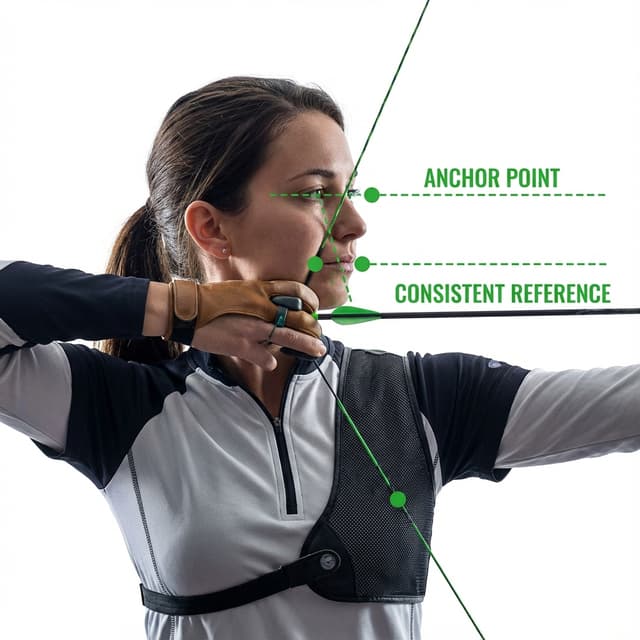
- Ignoring finger position — Whether you use a tab or glove, the string must sit in the same spot on your fingers every time—the first joint crease, not the fingertips and not the deep finger pad.
- Switching between tab and glove frequently — Each requires slightly different muscle memory for the release. Pick one for your main discipline and commit to it.
- Using a glove for string walking — The stitching between finger stalls catches on the string as you slide your hand, causing inconsistent nock point placement.
Track Your Setup Improvements
Switching finger protection or breaking in a new tab? ArcheryBuddy lets you log your equipment changes and track how your group sizes and scores evolve as you dial in your setup. See the data behind your improvement.
📋 Key Takeaways
- ✓Finger tabs provide the most consistent release surface and are preferred for competitive target and barebow archery
- ✓Shooting gloves offer simplicity, better feel, and convenience for traditional archery and bowhunting
- ✓Cordovan leather is the premium material for tabs—smooth, durable, and consistent after break-in
- ✓Break in a new tab properly with conditioning, volume shooting, and burnishing before relying on it
- ✓Whichever you choose, commit to it and focus on placing the string in the same finger position every shot